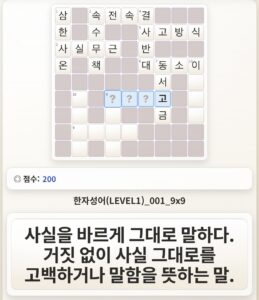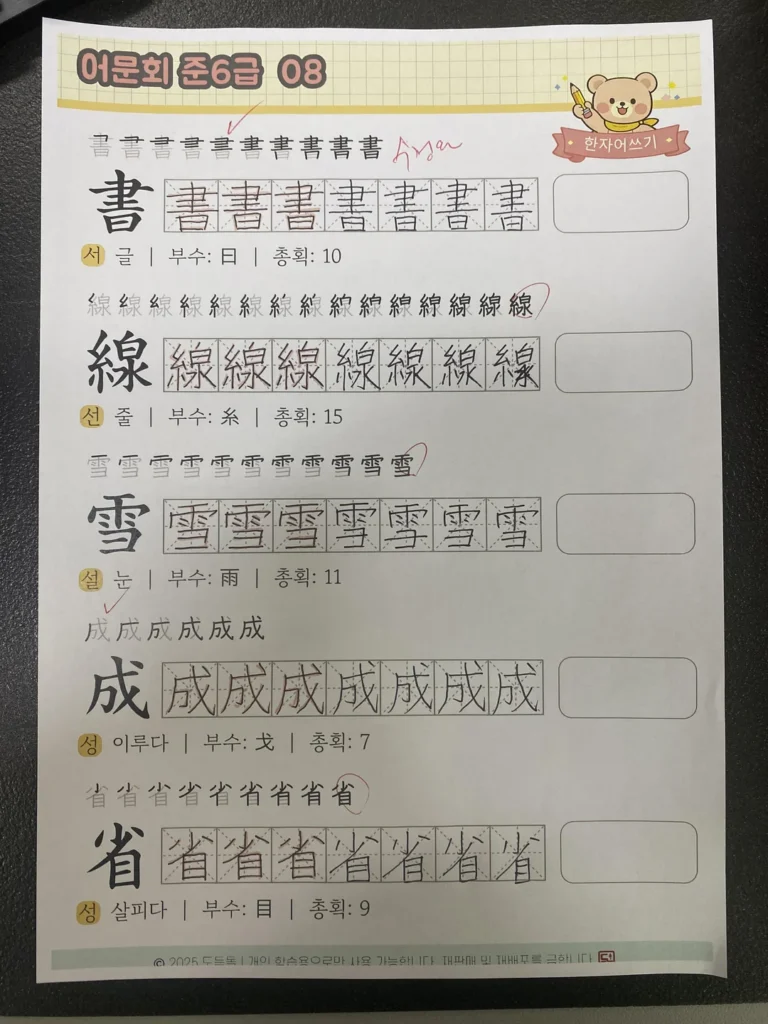
For advanced learners who have already achieved a high level of proficiency in Korean, Hanja (Chinese characters) represents both an exciting new frontier and the most effective “fast-track” to mastering high-level vocabulary. This is because a solid grasp of Hanja is essential for truly navigating the nuances of news, politics, and complex social issues.
Reflecting this importance, many Koreans take the Hanja Proficiency Test to formally certify their skills. Among elementary school students in Korea, it has become one of the most popular and recognized exams, standing alongside the Korean History Proficiency Test as a staple of academic achievement. In my own experience in the classroom, I see many students who already hold these certifications, proving that Hanja is an integral part of the Korean educational landscape.
However, Hanja should not be viewed as a mere memorization task for an exam or a daunting chore involving complex stroke orders. On the contrary, it is the single most powerful key to unlocking the hidden logic and structural principles of the Korean language.
Did you know that over 70% of Korean vocabulary is based on Hanja (Chinese characters)? When you first start learning Korean, understanding the meanings behind these basic roots is much more efficient than simple rote memorization. It works just like English prefixes and suffixes; once you know the root, you can easily guess the meaning of unfamiliar words!
For example, let’s look at the character 학 (學 – Hak), which is associated with “learning.” Once you realize that ‘Hak’ connects to education, words like Hak-gyo (School), Hak-saeng (Student), Hak-won (Private academy), and Dae-hak-gyo (University) all start to make sense as part of the same family. Even subjects like Su-hak (Math) or Gwa-hak (Science) become much easier to remember.
The same applies to vocabulary related to food. If you understand that 식 (食 – Sik) means “eat” or “food,” you’ll have a “lightbulb moment” realizing why Um-sik (Food), Sik-dang (Restaurant), and Sik-sa (Meal) all share that same sound. From menu items like Han-sik (Korean food) to household items like Sik-tak (Dining table), this single root unlocks dozens of words.
Finally, knowing 수 (水 – Su), which means “water,” will make your daily life in Korea much easier. You’ll see that Saeng-su (Mineral water), Eum-ryo-su (Beverage), Su-yeong (Swimming), and even the Bun-su (Fountain) in the park are all connected by the common concept of “water.”
The best part is that you don’t need to go through the difficult process of learning how to write these complex characters by hand. Instead of mastering every stroke, simply discovering which Hanja is hidden inside your everyday Korean words is enough. The moment you understand these building blocks, your vocabulary study will become faster and far more effective.
PPencil is currently preparing a Hanja practice workbook specifically designed for foreigners. It will be officially released and available in our shop very soon, so stay tuned!
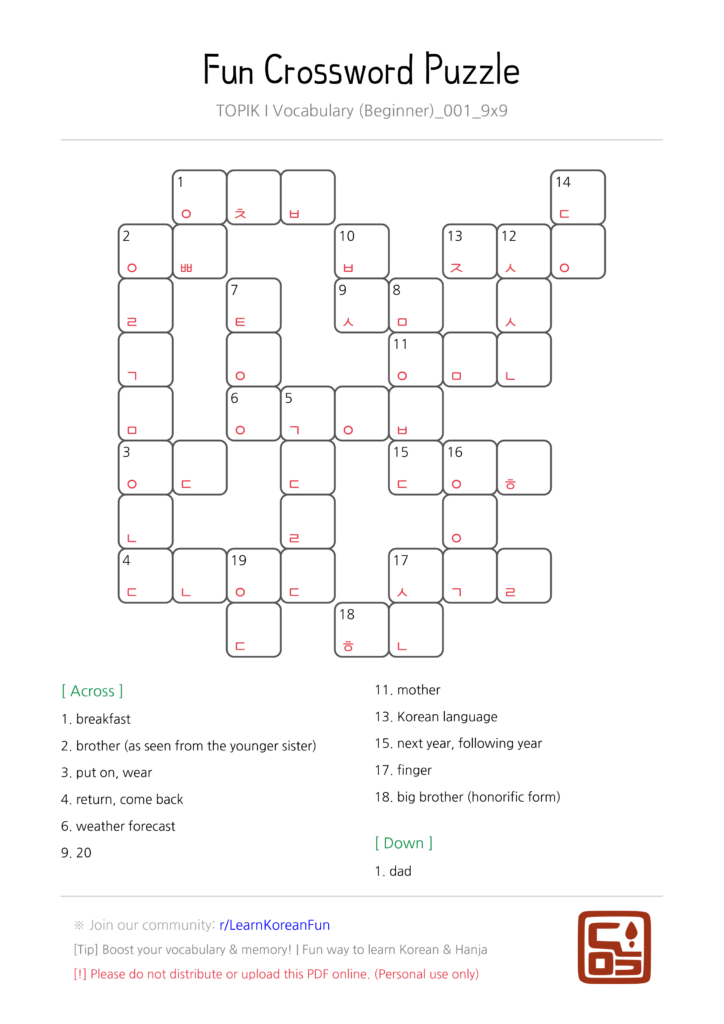
If you would like to explore the Korean Vocabulary Crossword Puzzle for Beginners (TOPIK I) – 10 Sets PDF prepared by PPencil, please check out the link below